Faith, Focus, and Freedom from Anxiety
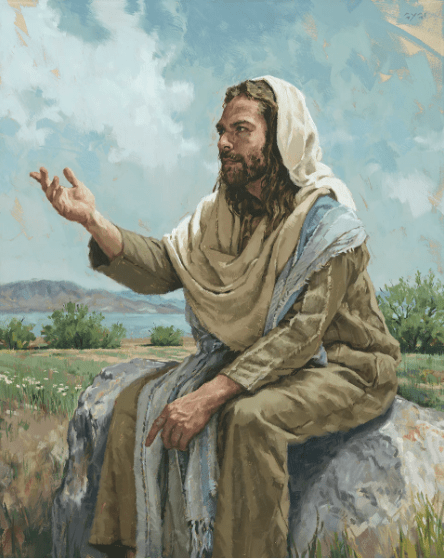
The teachings of Christ in the Sermon on the Mount are central to the faith of all His disciples. More than that, they embody the very ideals that those who love Him strive to live by in mortality. As President Howard W. Hunter declared in October 1994, “The teachings of the Master in the Sermon on the Mount are not outdated. They are the essence of the gospel of Jesus Christ and should be the very center of our lives.”
These sacred teachings can be found in Luke chapter 6 (often called the Sermon on the Plain), and in 3 Nephi chapters 12 through 14 in the Book of Mormon. However, they are most commonly examined in Saint Matthew’s gospel, chapters 5 through 7.
At the very heart of that sermon is Matthew chapter 6. This chapter of scripture not only captures the central message of the Sermon on the Mount, but reveals the very character, priorities, and divine nature of Christ Himself. In Chapter 5, Jesus has described the character of His true followers. Now in Chapter 6, the Savior shifts and teaches us how to strive to live the practices of true discipleship. This chapter focuses on the inner life of a disciple, and here the Lord shows us His true and eternal perspective. In doing so, He teaches us what every follower of Christ should truly be striving to accomplish in life: to live fully for God, and not for the world.
Verses 1–6 teach us to guard against pride in seeking the praise and admiration of others. This is a common trap. As human beings, we naturally long for affirmation, and in the context of community worship, it’s normal to hope that our efforts are seen and appreciated. In fact, it is a blessing when the Lord allows us to witness how our service has impacted others. So, what is the difference? How do we rightly receive appreciation without falling into the desire to “be seen of men”?
This question becomes even more important when we recall that earlier in the same sermon, Christ commanded us to “let our light so shine before men” (Matthew 5:16). How can we strive to be a light and an example to others, while still avoiding the danger of performing righteousness for the sake of visibility? How do we live in such a way that brings glory to God—not to ourselves?
The answer lies in our heart: our true desire. If no one ever acknowledged your efforts, yet you felt prompted by the Spirit to speak, teach, or serve, would you still do it? Why are you doing it in the first place? If your motivation is a sincere desire to obey the Lord and follow His promptings, then your heart is in the right place. In that case, you are living the balance Christ teaches: letting your light shine without seeking to be “seen of men.”
Ask yourself: if no one liked what you said, would you still share it? If some even opposed it, would you remain faithful to what you felt called to do? If the answer is yes, then take comfort. You are walking with integrity before God, and He who “seeth in secret shall reward thee openly.”
Verses 5 and 6 naturally lead into one of the most profound teachings the Lord ever gave on the subject of prayer. In verses 5 through 13, we are blessed with some of the most vital and powerful instruction in all of scripture regarding how, and why, we pray.
Verse 5 begins by calling us to examine the motives of our hearts. Then, in verse 6, Christ shows us a deeper understanding of prayer’s true purpose: the nature of prayer is to nurture a personal and private relationship with God.
True disciples of Christ seek a real, vital, and private relationship with Him. And, like any important relationship, communication is essential. Frequency, honesty, vulnerability; these are the hal;lmarks of every powerful bond we have with those whom we are closest, and they are equally vital in our relationship with Christ. This is the heart of prayer. It is not a ritual to check off on a spiritual to-do list, nor a formula to automate and release God’s blessings. To treat prayer that way diminishes both its power and the relationship it is meant to deepen.
One of the most beautiful and powerful teachings of Christ (and a personal favorite of mine) is found in verse 8, “your Father knoweth what things ye have need of, before ye ask him.” God already knows us. He already loves us. Prayer is not to inform Him of our needs, but to draw us closer to Him because of His perfect love.
With that in mind, verses 9 through 13 present a divine outline for addressing God. This is not a model merely to recite. It is a blueprint for heartfelt, reverent, and spiritually grounded communication with our Heavenly Father.
One more detail in verse 6 is worth emphasizing. When the Lord instructs us to enter our closet, He is teaching us the importance of having a personal, sacred space where we can commune with Him. President Russell M. Nelson has taught about the need to make our homes “sanctuaries of faith.” Do you have such a place? A private and consistent space where you can meet with God regularly? Creating that kind of sanctuary (no matter how simple) invites divine peace into your home and your heart. And I testify that those efforts will be rewarded by a God who sees in secret.
As the Lord concludes His teaching on prayer, He does so by intentionally emphasizing one of the most repeated and vital principles in all of His teachings: the necessity of forgiveness. Few spiritual truths are taught by our Lord more frequently, more directly, and more powerfully than this. And here, Christ places it at the heart of prayer itself.
By inserting the command to forgive others into the structure of the Lord’s Prayer, Jesus reveals just how central forgiveness is to the life of a true disciple. It’s not an optional virtue or a spiritual finishing touch. It is a core condition of the heart that shapes our relationship with God. In fact, Christ’s placement of this teaching here may highlight more than any other passage just how essential forgiveness is in the mind, heart, and walk of every follower of Christ. Disciples of Christ must truly strive to forgive others in all aspects and contexts in order to truly be endowed with the power to be transformed into the people which the Lord desires that we become, to live in Him, and to find peace in this life and eternity. As President Russell M. Nelson has taught, “When we choose to forgive others, we allow the Lord to remove the poison from our souls. We permit Him to soothe and soften our hearts so we can find peace. The Savior’s Atonement makes that possible. And it is by forgiving others that we can fully access His forgiveness for us.” (“The Healing Power of Forgiveness,” General Conference, April 2021)
The principle of fasting, and it’s being closely tied to prayer, is emphasized by its placement immediately following the Lord’s instruction on prayer in verses 16 to 18. Once again, Christ warns us against pride and the temptation to seek the approval of others. However, I believe that the most powerful message in this passage is the connection itself of prayer and fasting. By placing His teachings on fasting directly after prayer, the Savior teaches us about the spiritual link between the two.
Fasting and prayer are not isolated practices. In fact, they are deeply interwoven. Together, they form a vital aspect of discipleship. They strengthen, and amplify the other. Their pairing in this passage illustrates not only their individual importance, but their combined power in drawing us closer to God.
As beautiful and profound as all the preceding teachings in this chapter are, they ultimately build to the teachings found in verses 19–34. In Matthew Chapter 6, verses 19-34, everything converges. Not just the message of Matthew 6, or even the Sermon on the Mount as a whole, but the whole of the Gospel of Christ, and even the very purpose of our mortal journey.
Inverses 19–21, Jesus admonishes us to examine our hearts by asking, in effect, “What do you truly treasure?” Christ is not teaching us here only about money. This teaching is about desires, leading to our identity, and leading ultimately to our eternal destiny. While the Lord uses the term ‘riches,’ His teaching is far beyond a rebuke of greed or materialism. Jesus is not merely saying, ‘You can’t take it with you.’ He’s teaching us that we are all shaped by what we love most.
Our desires direct our attention, shape our actions, and ultimately form our identity. We all act in accordance with our own self-image. Eventually, we become what we treasure. That process begins not with behavior, but with what we treasure and desire in our hearts. If our desires are centered on earthly things, our life will follow an earthly trajectory. We may obtain those things which can produce pleasure and temporary satisfaction. But we will not obtain true joy which lasts in both this life and eternally. However, if our treasure is in heaven, and if our heart and focus is truly fixed on Christ, only then can God prevail in our lives, bring us peace, joy and fulfillment in all circumstances of life, and transform us into something eternal.
Look closely at verses 22–23. When Jesus speaks of the “eye,” He is referring to our focus. What do we fix our hearts and minds upon? This includes our desires, but even more importantly, our perspective. When our eye is single to God, only when we are blessed with the ability to see through an eternal lens, can our whole being be filled with light. Only then can we see life as it truly is. Priorities shift. Desires are changed. Everything finds its proper context.
On the other hand, when our perspective is clouded by a limited, mortal view, we stumble right from the outset. Our life is unavoidably misaligned. Decisions lose their clarity. Fear and uncertainty are the inevitable result. Not the peace and trust which can only come when we have a true perspective and an “eye single to the glory of God”.
Perspective is everything! There can be no greater blessing in this life than the gift of a true, eternal perspective. The ability to see ourselves and our lives as God sees them. As King Benjamin taught, “the natural man is an enemy to God” (Mosiah 3:19), and part of that condition is seeing ourselves only as physical beings, driven by earthly needs and desires. Only through the influence of the Holy Ghost, we are able to see the truth: we are spiritual beings, temporarily living in mortality as part of a divine pilgrimage of discipleship.
Only with this God-given perspective can our priorities be rightly ordered. Only with this eternal view (a blessing given to us by God through the Holy Spirit) can we experience the peace and joy that comes from the freedom of living in Christ as we fully trust, and rely upon God.
Verse 24 of Matthew 6 contains one of the most important and powerful statements ever made by the Lord: “Ye cannot serve God and mammon.” The word serve is instructive. Jesus doesn’t say, “You shouldn’t,” but “you cannot.” This isn’t a warning against greed, it’s a propositional statement about divided allegiance. We may like to imagine that we have control over our desires. We may think that we love Jesus and His gospel, but we also love our career, home, cars, our position in life as well. Christ is important, but only one of many things in our live which are important. So we think. But the truth is, whatever we nurture in our hearts will eventually shape our identity and claim our loyalty. Desire becomes devotion, and devotion becomes mastery.
Jesus makes it clear: we cannot live for two masters. One will displace the other. Christ and the world both will both demand complete allegiance. The pursuit of wealth, power, prestige, influence, or admiration is a rival lord. And Christ will not share the throne of our hearts. He demands, and certainly deserves, our whole selves: “Thou shalt love the Lord thy God with all thy heart, and with all thy soul, and with all thy mind, and with all thy strength.” This is a call of total surrender. In one form or another, Jesus says to each one of us, “Go, sell all that thou hast, and come, follow me.”
Make no mistake: this is a totalitarian demand given us by Christ. But it is a loving one. As Jesus says, “Either he will hate the one and love the other; or else he will hold to the one and despise the other.” There is no room for compromise. To give our hearts to the things of this world, whether it be money, status, physical possessions, or the praise of men, is to forfeit the eternal perspective which alone can give meaning, peace, and fulfillment in this life and in the life to come.
This eternal perspective is what empowers us to live the teachings that follow in verses 25–34. With our hearts centered on God and our eyes fixed on eternal things, we can then let go of one of mortality’s heaviest burdens: anxiety.
These verses contain some of the most beautiful and powerful teachings of our Lord. On many occasions He has used them to bring peace to my soul and fill my heart with encouragement and hope. Of all the Savior’s teachings, these are among my personal favorites. They encompass the deepest parts of my faith and my love for the Lord, and have sustained me in times of need.
Here, Jesus addresses the everyday concerns that weigh on all of us in mortality: What shall we eat? What shall we drink? What shall we wear? He is speaking not only of food, water, and clothing, but of all the practical necessities of life. Money, bills, stability, provision. These verses speak directly to the common anxieties of daily living, the very things that occupy so much of our time, energy, and worry.
Christ invites us to see these concerns from His true and eternal perspective: “Is not the life more than meat, and the body than raiment?” (v. 25). In essence, the Savior is saying, If you truly understand who you are, and who God is, then you can trust that your Father knows your needs and will care for you.
The lilies of the field and the birds of the air are not anxious, and yet they are sustained by God’s hand. How much more, then, will He care for those made in His image, and who are striving to walk the path of discipleship?
As the great Reformer and theologian John Calvin once observed, “There is no more fatal plague for all godly living than to be absorbed with earthly cares… We are to strive to be citizens of heaven while we are pilgrims on earth.”
Verse 27 of this chapter is one which is personally very meaningful for me. Recently, Christ has taught me profoundly through this verse. It holds powerful meaning for those struggling with anxiety and fear: “Which of you by taking thought can add one cubit unto his stature?” This simple but powerful question teaches us that worrying about the future does not add anything to our lives; it does not change the outcomes or lengthen our days. It cannot help us. It can only hurt. Indeed, anxiety can rob us of peace and distract us from trusting in God’s timing and providence. As Elder Dieter F. Uchtdorf taught, “Anxiety and worry can consume us if we let them, but faith in God and His love is our antidote.” Matthew 6:27 invites us to lay down the heavy burden of worry and to place our trust fully in our Heavenly Father, who cares deeply for us and knows exactly what we need, when we need it.
Of course this is not an invitation to idleness. It is a teaching to trust. In fact it is an invitation to strive for a radical, and childlike trust in the goodness and providence of our Heavenly Father, and to find the peace that only it can provide.
The antidote to anxiety is mortality is not control, but confidence in God. And so, the Savior offers this transformative command:
“Seek ye first the kingdom of God, and his righteousness; and all these things shall be added unto you” (v. 33).
When we see ourselves and our lives, with true and eternal perspective, we begin to understand: we were never meant to carry the weight of the world. We were meant to carry only faith, and to let God carry us.
Matthew 6:34 is my favorite scripture: “Take therefore no thought for the morrow: for the morrow shall take thought for the things of itself. Sufficient unto the day is the evil thereof.” In this verse, the Savior offers a loving and powerful invitation: stop carrying tomorrow’s burdens today. Christ knows how hard it is. He knows us perfectly. He knows how easily our minds look ahead, thinking about the “what-ifs”, and worst-case scenarios.. But He teaches and invites us to live in the present moment, where His grace is sufficient and His peace is available. Each day brings its own challenges, and also its own blessings. This final verse is truly the soul of Matthew Chapter 6. It is a call to release our fear, to resist the praise of the world, to allow God to prevail in our lives with the Holy Spirit focusing our hearts toward heaven, and to trust fully in God who sees, knows, and always provides.
In this chapter, Christ offers not just commandments, but a vision and invitation for a higher and holier way of life. A life where the heart is turned fully to the Father, and the soul finds rest in Him.
Any person who will read Matthew Chapter 6 with an open heart, and a true desire to learn from the Lord will be taught by Him. The Savior’s words will speak peace to their soul and clarity to their mind. Ask yourself what you are striving for, what you are fearing, and where your treasure truly lies. Christ’s words in this chapter are an invitation to trust Him. To live more simply, and to walk through life with Him. When we seek Him first, everything else will fall into its proper place.

 LDS Living In Christ